
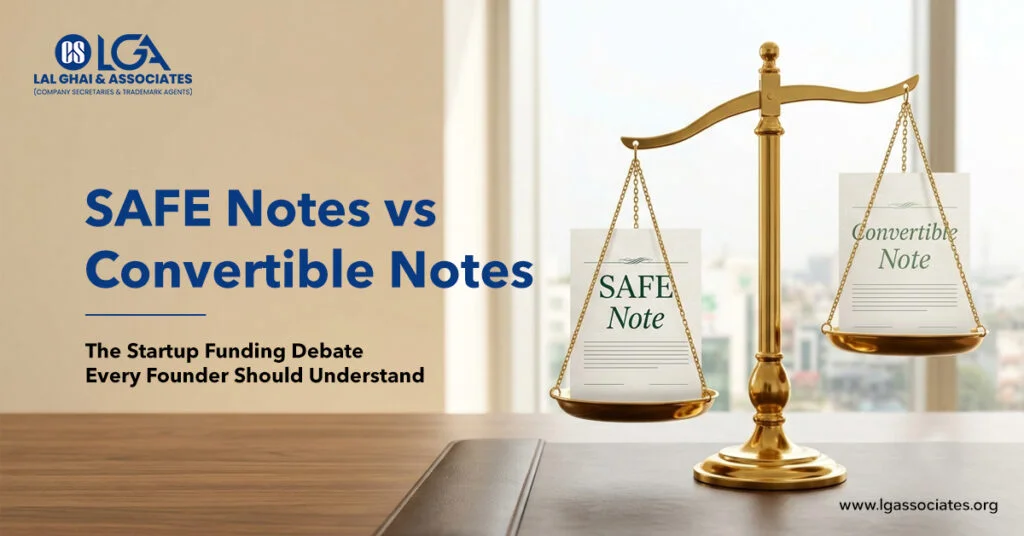
SAFE Notes vs Convertible Notes: The Startup Funding Debate Every Founder Should Understand

SAFE Notes vs Convertible Notes: The Startup Funding Debate Every Founder Should Understand
“Not every person who controls a company sits on its Board.”
In the corporate world, influence is not always accompanied by designation.
A person may never be formally appointed as a director, may not attend every board meeting, and may not even appear in the company’s statutory records—yet the Board routinely acts on that person’s instructions. Such individuals are commonly referred to as Shadow Directors.
While the title may sound informal, the legal consequences are anything but. In many jurisdictions, shadow directors can be subjected to duties and liabilities similar to those of formally appointed directors, despite never holding office.
So, who exactly is a shadow director, and why should companies, investors, promoters, and advisors be aware of this concept?
Imagine This...
Rahul has built an AI-powered logistics startup.
An angel investor wants to invest ₹1 crore.
The problem?
Rahul believes the company is worth ₹30 crore.
The investor believes it’s worth ₹15 crore.
Instead of spending weeks negotiating valuation, both agree to postpone the discussion until the startup raises its Series A funding.
But how should the investment be structured?
This is where SAFE Notes and Convertible Notes come into play.
What is a SAFE Note?
SAFE stands for Simple Agreement for Future Equity.
Created by Y Combinator in 2013, it allows investors to invest today and receive shares later—usually when the startup raises its next funding round.
Think of it as a promise of future equity, not a loan.
There is:
- No interest
- No repayment obligation
- No maturity date
The investor simply waits until a future financing event occurs.
For founders, this means they can focus on building the business instead of worrying about debt repayments.
What is a Convertible Note?
A Convertible Note begins life as a loan.
The investor lends money to the startup, but instead of expecting cash repayment, the loan usually converts into equity during the next funding round.
Unlike a SAFE, however, a Convertible Note includes:
- Interest
- A maturity date
- Repayment rights if conversion doesn’t happen
In simple words:
A SAFE says, “I’ll become a shareholder later.”
A Convertible Note says, “I’m your lender today and your shareholder tomorrow.”
That single distinction changes everything.
The Biggest Difference: Debt vs. Equity
Suppose a startup fails to raise another funding round.
With a SAFE, investors generally have no right to demand repayment because the investment was never a loan.
With a Convertible Note, investors may have the contractual right to seek repayment once the maturity date arrives.
This is why investors often consider Convertible Notes less risky than SAFEs.
For founders, however, SAFEs reduce financial pressure because there is no debt hanging over the business.
Why Do Investors Agree to Wait?
Early investors take the biggest risk.
To reward them, both SAFEs and Convertible Notes usually include special benefits.
Valuation Cap
Imagine a startup is valued at ₹40 crore when the investment is made.
Two years later, the company becomes worth ₹200 crore.
Instead of converting at ₹200 crore, the early investor converts at the agreed valuation cap, receiving significantly more shares.
This rewards them for believing in the startup before everyone else.
Discount
Suppose new investors purchase shares for ₹100 each.
An early investor with a 20% discount converts at ₹80 per share.
More shares.
Same investment.
Higher reward.
So Which One is Better?
The answer depends on whose side you’re on.
If you’re a founder…
You’ll probably prefer a SAFE because:
✔ No interest
✔ No repayment pressure
✔ Faster documentation
✔ Lower legal costs
✔ More founder-friendly
If you're an investor...
You’ll likely favour a Convertible Note because:
✔ It starts as debt
✔ Interest increases your investment
✔ Better protection if funding doesn’t happen
✔ Greater negotiating leverage
What About India?
This is where many founders get confused.
SAFE Notes became extremely popular in Silicon Valley.
However, India follows a different legal framework.
Indian startup funding must comply with the Companies Act, 2013, FEMA regulations, and RBI guidelines, especially when foreign investment is involved.
As a result, Convertible Notes have gained much wider legal acceptance in India, particularly for recognised startups.
Many Indian investors therefore prefer Convertible Notes or customised investment agreements that achieve similar commercial outcomes while remaining compliant with Indian law.
The Final Verdict
SAFE Notes and Convertible Notes solve the same problem—but in very different ways.
A SAFE is built for speed, simplicity, and founder flexibility.
A Convertible Note is built for security, legal protection, and investor confidence.
Neither is universally superior.
The right choice depends on the stage of the startup, the bargaining power of the parties, the jurisdiction, and the nature of the investment.
As India’s startup ecosystem matures and funding structures continue to evolve, understanding these instruments is no longer just a matter for lawyers or investors. Every founder planning to raise external capital should know exactly what they’re signing—because the paperwork signed today can determine who owns the company tomorrow.
Before you choose between a SAFE Note or Convertible Note, make sure your funding structure is legally compliant and founder-friendly.
Get expert guidance on structuring your startup funding to protect founder interests, ensure regulatory compliance, and avoid complications during future investment rounds.
www.lgassociates.org | +91-94636 40466 | info@lgassociates.org