
Know What Your Business Is Worth—and Why
Business Valuation Consultancy
The value of a business cannot be determined by revenue, assets or profits alone. Its true worth may also depend on future cash flows, industry position, customer concentration, intellectual property, management capability, financial risk, market conditions and the purpose for which the valuation is required. At Lal Ghai & Associates, we provide structured Business Valuation Consultancy services to companies, startups, promoters, investors and professional advisors.
Here’s something most founders don’t find out until it’s already a problem: an FMV certificate prepared for an ESOP grant, a valuation report for a preferential share allotment, and a pricing certificate for a FEMA cross-border transaction each follow completely different rules, use different formats, and — in several cases — legally have to be signed by a different category of professional altogether.
Under Section 247 of the Companies Act, 2013, wherever the Act calls for a valuation of property, shares, debentures, securities, goodwill, or net worth, it must be carried out by an IBBI Registered Valuer, appointed by the audit committee or board — not handed directly to a promoter’s preferred CA. Income Tax Rule 11UA valuations for fundraising and share transfers add a separate layer: a DCF valuation there needs a SEBI Category I Merchant Banker, while an NAV valuation can be certified by a practising Chartered Accountant. FEMA pricing for cross-border share transactions accepts either a Merchant Banker or a practising CA, depending on the transaction. Three different laws, three different qualifying professionals, and a report built for one cannot simply be relabelled for another.
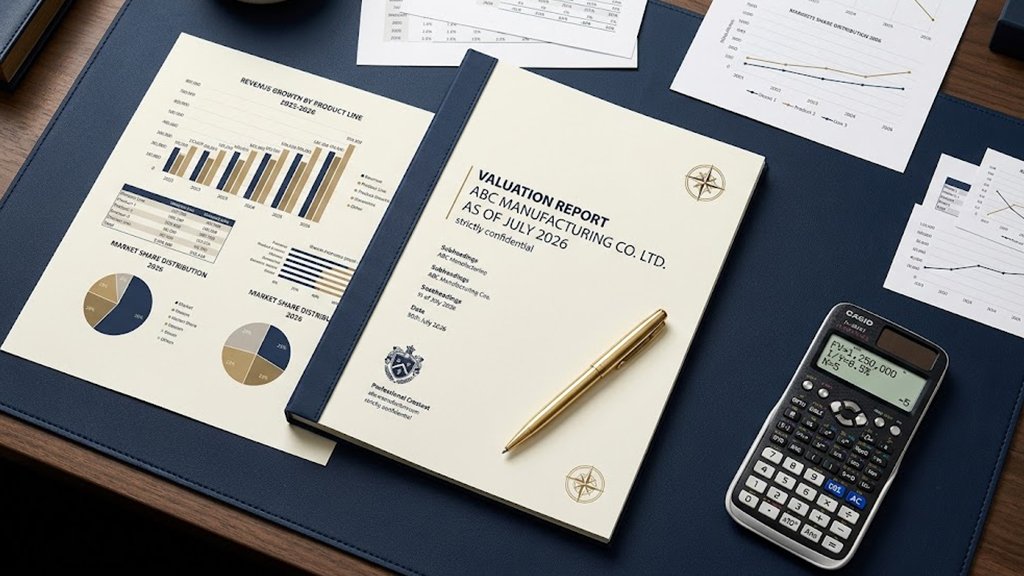
What Is Business Valuation?
Business valuation is the process of estimating the economic value of a company, business interest or equity shareholding on a specified date.
A valuation may be required to determine:
- The value of an entire company
- The value of equity shares
- The value of a specific ownership interest
- The enterprise value of a business
- The value of intangible assets
- The value of a startup or early-stage venture
- The fair value of shares for a proposed transaction
The outcome is generally supported by financial analysis, assumptions, valuation methods and the professional judgement of the valuer.
A valuation should always be prepared for a clearly defined purpose because the appropriate basis, methodology and regulatory requirements may differ from one transaction to another.
Where a Business Valuation Report Is Actually Required
Share Issues & Preferential Allotment
Companies Act Section 62 and Section 247 valuations for issuing new shares to investors, promoters, or existing shareholders at a defensible fair value.
ESOP Grants
Fair Market Value certificates attached to the board resolution before employee stock options are issued or exercised.
FEMA Cross-Border Transactions
Pricing certificates for foreign investment into Indian shares, or share transfers between resident and non-resident parties, certified by a Merchant Banker or practising CA.
Mergers, Demergers & NCLT Schemes
Swap ratio valuations for amalgamations and corporate restructuring, filed as part of the scheme presented to the NCLT.
IBC / Insolvency Matters
Fair Value and Liquidation Value assessments during CIRP, liquidation, and pre-packaged insolvency, now governed by mandatory International Valuation Standards.
M&A, Slump Sale & Exit Planning
Valuation to support negotiation, purchase price allocation, and stamp duty cross-checks for business transfers and strategic sales.
The IBC Valuation Rules Just Got Considerably Stricter
If your business is anywhere near an insolvency, restructuring, or liquidation scenario, this matters more than it might seem. IBBI has notified International Valuation Standards as the binding standard for every valuation conducted under the Insolvency and Bankruptcy Code — covering CIRP, liquidation, voluntary liquidation, pre-packaged insolvency, and personal guarantor bankruptcy, with no exceptions. Reports now have to explicitly state the Basis of Value — Fair Value or Liquidation Value — with a clearly documented methodology rationale, rather than the older, looser practice of citing “internationally accepted valuation standards” without explaining why a particular approach was weighted the way it was.
A separate change specifically affects smaller companies: MSME corporate debtors undergoing liquidation may now appoint a single registered valuer per asset class instead of two — reducing cost, but also meaning the entire responsibility for standards compliance sits with that one valuer’s report. If your business or a debtor you’re owed money by is heading toward NCLT, this is exactly the kind of procedural shift worth flagging early rather than discovering during proceedings.
Documents Required for Business Valuation
The exact information required depends on the assignment.
Common documents include:
- Certificate of incorporation
- Memorandum and Articles of Association
- Capitalisation table
- Shareholding pattern
- Audited financial statements
- Latest management accounts
- Financial projections
- Income-tax returns
- Details of borrowings
- Fixed asset register
- Customer and supplier information
- Product-wise revenue details
- Related-party transactions
- Material agreements
- Intellectual property records
- Business plan
- Industry information
- Details of pending litigation
- Previous valuation or investment documents
Complete and reliable information helps improve the quality of the valuation analysis.
Our Business Valuation Services
Business and Enterprise Valuation
We assess the overall economic value of a company by examining its financial performance, business model, assets, liabilities, growth potential and risk profile.
Equity Share Valuation
We determine the value of a company’s equity shares for transactions such as share allotments, transfers, buybacks, fundraising and ownership restructuring.
Startup Valuation
Our startup valuation process considers factors such as market opportunity, business model, traction, intellectual property, customer growth, management capability, funding stage and execution risk.
Fundraising Valuation
We help businesses assess a commercially supportable valuation range for angel investment, venture capital, private equity and pre-IPO fundraising
ESOP and Sweat Equity Valuation
We assist companies with valuation support for employee incentive plans, option grants and sweat equity transactions.
Valuation for Corporate Restructuring
We help assess the valuation implications of the proposed structure and coordinate with legal, taxation and compliance professionals where required.
Why Businesses Choose LGA for Valuation Coordination
- ICSI Peer Review Recognised firm coordinating with IBBI Registered Valuers, Merchant Bankers, and Chartered Accountants as the engagement requires
- Direct experience with Companies Act, FEMA, Income Tax, and IBC valuation contexts under one roof
- We identify the correct regulatory trigger first, so you never end up with a report that can't be used for its intended filing
- Awareness of the latest regulatory shifts — including the 2026 IVS mandate for IBC valuations — so your report reflects current rules, not outdated ones
- Documentation built to withstand scrutiny — from a bank, an NCLT bench, or a tax officer — not just a number on a page
- Since 2014 supporting manufacturers, startups, and family businesses across Punjab through share issues, ESOPs, and restructuring
- Offices in Ludhiana, Mohali, and Gurgaon — in-person coordination for site inspections where physical assets are involved
Frequently Asked Questions
Business valuation consultancy involves analysing the financial, operational and commercial position of a company to estimate the value of the business or its equity shares for a specific purpose.
A valuation may be required for fundraising, share transfers, mergers, acquisitions, restructuring, ESOPs, taxation, regulatory compliance, shareholder exits and strategic planning.
A business may be valued using the income approach, market approach, asset approach or a combination of methods. The appropriate method depends on the company’s business model, financial information, growth stage and valuation purpose.
Turnaround generally runs one to four weeks depending on complexity, and fees typically range from around ₹25,000 for a straightforward single-purpose report to well over ₹2,00,000 for a multi-framework valuation covering Companies Act, FEMA, and Income Tax requirements together. Complexity — not company size alone — is what drives both timeline and cost, since a valuation touching multiple regulatory frameworks needs separate methodology and documentation for each.
A valuation represents an estimate as of a specified valuation date.
It does not remain valid indefinitely because financial performance, market conditions and business circumstances can change.
A fresh or updated valuation may be required if the transaction is delayed or material circumstances change.
We can assist with transaction coordination and valuation advisory for transactions involving resident and non-resident parties.
The assignment must be evaluated under the applicable foreign exchange, company law and taxation requirements in force at the relevant time.
It depends on the purpose — an IBBI Registered Valuer for Companies Act and IBC matters, a SEBI Category I Merchant Banker for DCF valuations under Income Tax Rule 11UA, and a practising Chartered Accountant for NAV-based Income Tax or FEMA certificates. Since February 2019, only registered valuers can undertake valuations required under the Companies Act, 2013 and the Insolvency and Bankruptcy Code, 2016. Using the wrong professional for a given regulatory context is one of the most common reasons a valuation report gets rejected on filing.
No. Each regulatory context — ESOP, preferential allotment, FEMA pricing, slump sale — has its own required methodology, format, and authorised signing professional, and a report prepared for one cannot simply be relabelled for another. An ESOP FMV certificate attached to a board resolution follows a different process than a Section 62 preferential allotment valuation, even if the underlying business is the same. We flag this early precisely because founders often assume one report can be stretched to cover multiple needs.
Yes. FEMA pricing guidelines require a valuation certificate for foreign investment into Indian company shares or transfers between resident and non-resident parties, certified by a SEBI-registered Merchant Banker or a practising Chartered Accountant. This certificate is submitted to the authorised dealer bank as part of the transaction filing, and getting the pricing methodology wrong can delay or complicate the entire cross-border transaction.
Get the Right Valuation, for the Right Reason, the First Time
Tell us what the valuation is for — a share issue, ESOP, FEMA filing, or NCLT matter —
and we’ll confirm exactly which professional and methodology your situation needs. Free requirement check, no obligation.
Email: info@lgassociates.org | Offices in Ludhiana – Mohali – Gurgaon