- +91-94636 40466
- info@lgassociates.org

Foreign Exchange Management Act – RBI Compliance India
FEMA & RBI Compliance Services
Cross-border transactions can involve more than receiving or sending funds. The parties, instrument, pricing, sector, route, purpose, timing and reporting record may all matter. Lal Ghai & Associates helps businesses organise the facts, identify relevant FEMA and RBI questions and coordinate the corporate and reporting work within the agreed scope.
Most business owners in don’t think about the Foreign Exchange Management Act until something goes wrong. A bank holds up a remittance. The RBI sends a query. A chartered accountant flags a missing filing during an audit. By then, what could have been a routine ten-minute form has turned into a stressful, often expensive, compliance headache.
We’ve handled FEMA and RBI matters for manufacturers, exporters, and growing companies across India for years now, and the pattern is almost always the same — nobody told them the rule existed until they’d already broken it.
This page walks through what FEMA compliance actually involves, where India businesses usually trip up, and how we help fix or prevent these issues. No jargon-stuffed legal lecture — just what you actually need to know.

What Is FEMA and Why Should a Business Owner Care?
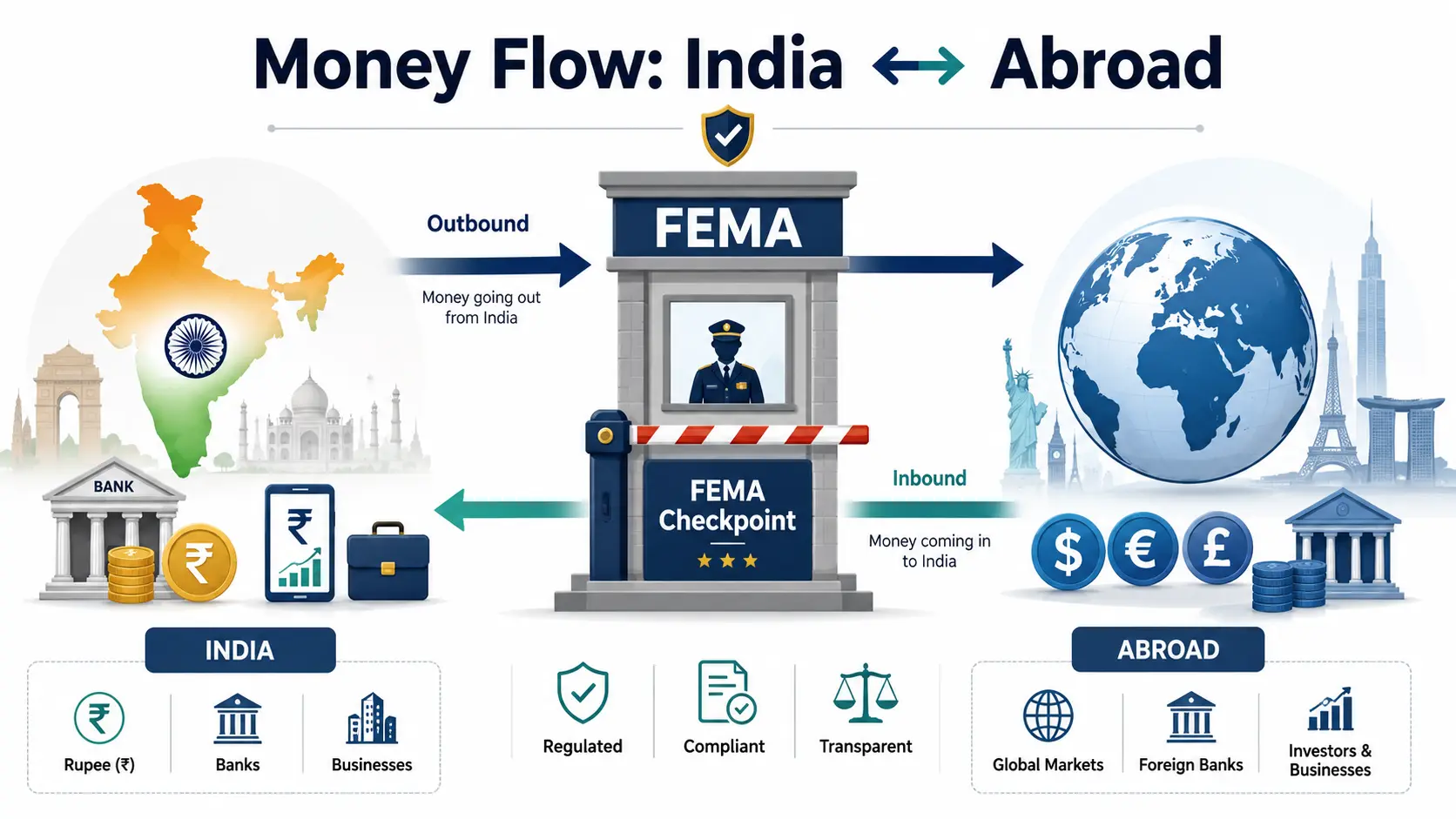
The Foreign Exchange Management Act, 1991 — FEMA for short — is the law that governs how money moves between India and the rest of the world. Every time your business deals with a foreign currency transaction, a foreign investor, an overseas subsidiary, or even property abroad, FEMA has something to say about how that should be reported and structured.
It’s administered by the Reserve Bank of India, and in practice, almost none of it happens directly between you and the RBI. Instead, it flows through your bank — specifically, a bank that’s been designated as an Authorized Dealer Bank. When you receive export proceeds, bring in foreign investment, or send money out, your AD Bank is the one collecting your paperwork and reporting it onward to the RBI.
Here’s the part that catches people off guard: FEMA isn’t optional or “best practice.” It’s law. And RBI regulations under FEMA carry real financial consequences if ignored — not jail-time-for-everyone consequences, but penalties that can run into lakhs, and in persistent cases, far more.
Who actually needs to worry about this?
We get asked this constantly, so here’s the honest answer:
- Exporters — anyone shipping goods or services outside India and receiving foreign currency payment
- Companies receiving Foreign Direct Investment — if even one shareholder is a non-resident, you're in FDI reporting territory
- Businesses with an NRI or OCI director, partner, or shareholder
- Companies setting up a branch, liaison office, or subsidiary abroad (called Overseas Direct Investment)
- Anyone who's taken an External Commercial Borrowing — basically a foreign currency loan
- Importers making payments abroad for goods, services, royalties, or technical know-how
- Textile and agro-export units dealing in regular cross-border transactions
- Family businesses bringing in NRI relatives as investors — this one trips up more businesses than almost any other category.
If you fall into any of these, FEMA compliance isn’t a “someday” item on your list. It’s already running in the background of your business operations.
The FEMA Filings Most Businesses Get Wrong (or Miss Entirely)
FC-GPR — When You Receive Foreign Investment
Picture this: a company in Mohali brings in an NRI investor — maybe a cousin settled in Canada, maybe an institutional fund — who puts money into the business in exchange for shares. The company issues those shares. Everyone’s happy.
Except RBI filings under FEMA require this to be reported through Form FC-GPR, filed via the RBI’s FIRMS portal, within 30 days of share allotment. Miss that window, and you’re now sitting on a contravention that needs to be regularised — usually through a compounding application — before you can do much else with that investment, including bringing in the next round.
We see this constantly. The deal closes, the lawyers handle the share purchase agreement, and somehow nobody circles back to file the FC-GPR. It’s not because anyone is careless — it’s because foreign exchange management isn’t part of most people’s day-to-day vocabulary, and the form isn’t something a regular CA necessarily flags unless they’re specifically watching for it.
FLA Return — The Annual Filing Almost Everyone Forgets
If your company has any foreign investment on its books — even from years ago — you likely need to file the Foreign Liabilities and Assets (FLA) Return every year by July 15th, regardless of whether anything changed during the year.
This one is brutal because it’s easy to forget. The investment happened once, years back. The business has moved on. Nobody’s thinking about it anymore. Then an audit or an RBI query surfaces three, four, five years of missed FLA returns, and now you’re dealing with a genuinely messy compounding process instead of a five-minute annual form.
ODI Filings — When Your Business Has Eyes on Foreign Markets
We’re seeing more of this lately — manufacturers setting up a small overseas entity to handle exports more efficiently, or opening a liaison office in the Gulf or Europe to manage buyer relationships directly. The moment you do this, you enter Overseas Direct Investment territory, which comes with its own RBI filings, annual performance reporting, and structuring rules under the Foreign Exchange Management (Overseas Investment) Rules.
Export and Import Payment Reporting
Every export shipment needs to be tracked against the foreign currency that eventually comes in — this is the Export Data Processing and Monitoring System (EDPMS) that your AD Bank manages. If payment doesn’t come in within the prescribed period (generally nine months from shipment), it shows up as an outstanding entry, and unresolved entries pile up into compliance trouble fast, sometimes affecting your bank’s willingness to process future transactions smoothly.
Compounding of Contravention — Fixing What's Already Gone Wrong
This is where a lot of our FEMA work actually happens — not preventing problems, but cleaning them up.
If a contravention has already occurred — a late FC-GPR, a missed FLA return, an ECB drawn down without proper reporting — FEMA gives you a legitimate path to fix it through compounding. You apply to the RBI (or in certain categories, the Enforcement Directorate), acknowledge what went wrong, and pay a compounding fee that’s calculated based on specific RBI formulas tied to the nature and duration of the contravention.
Why Businesses Specifically Run Into FEMA Trouble
It’s not that businesses are careless. It’s the specific shape of how cross-border business happens today.
A huge number of manufacturing and trading families have relatives settled abroad — Canada, UK, Australia, the Gulf, and other countries — and it’s completely natural for those relatives to invest in the family business back home. That can be a strong growth opportunity, but the moment an NRI relative’s money enters the company, FDI reporting requirements may apply, and many families are not aware of the compliance steps involved.
Add to that India’s strong export base — textiles, agricultural processing, auto components, hand tools, manufacturing, and trading — and you have constant cross-border transactions happening through regular business activity. This can involve EDPMS tracking, advance payment reporting, and in some cases, External Commercial Borrowing when a company wants foreign currency financing for plant expansion or business growth.
The mistake we see most often isn’t bad intent. It’s businesses treating FEMA as something their bank or CA “will handle.” Banks process what’s directly in front of them — your AD Bank may flag a transaction-level issue, but they are not auditing your entire historical compliance position. And general practice CAs, while excellent at tax and statutory audit, may not always specialize deeply enough in foreign exchange management to catch every RBI filing obligation hidden within a company’s structure.
That gap is exactly where we work.
How We Help — What Working With Us Actually Looks Like
For businesses already compliant and just need ongoing filing support
We track your FLA return deadlines, manage FC-GPR and FC-TRS filings as transactions happen, and keep your EDPMS entries current with your AD Bank. This is mostly quiet, background work — the kind of compliance that, when done right, you never have to think about.
Late Return Filing
We handle overdue ROC filings, including assessment of additional fees, preparation of pending forms, and coordination for timely submission—helping bring delayed compliances back on track.
For exporters and importers managing regular cross-border transactions
We coordinate with your AD Bank on EDPMS and IDPMS tracking, help resolve outstanding shipping bills, and advise on structuring advance payments and export realization timelines so you're not caught off guard.
For companies setting up overseas entities
We advise on ODI structuring from the start — what's permitted, what needs prior RBI approval versus what falls under the automatic route, and how to keep the annual performance reporting current once the entity is set up.
A Quick Word on Penalties — Because People Always Ask
Under FEMA, contraventions are civil in nature, not criminal — that distinction matters and tends to relieve a lot of anxious clients the moment we explain it. Penalties are generally calculated as a percentage of the contravention amount, often up to three times the sum involved where it’s quantifiable, or a fixed amount where it isn’t, with additional daily penalties for continuing contraventions.
That sounds alarming written out like that, and in genuinely serious or willful cases, it can be. But for the vast majority of Indian business situations we see — a late filing, a missed annual return, an honest oversight — the compounding route resolves things at a far more manageable figure than the maximum penalty provisions suggest. The key is not letting it sit unresolved, because penalties and complications tend to compound (in every sense) the longer something goes unaddressed.
Why Businesses Choose Lal Ghai & Associates
We Specialize in This Specific Gap
FEMA and RBI filings aren't a side service we offer alongside everything else — they're a dedicated part of our practice. We track regulatory updates, RBI circulars, and compounding formula changes the way a general practice firm simply doesn't have the bandwidth to.
We Work Alongside Your Existing CA
We're not asking you to replace your chartered accountant. Most of our FEMA engagements run in parallel with a client's existing CA relationship — we handle the foreign exchange layer, they continue handling tax and statutory audit.
We Treat Contraventions With the Discretion They Deserve
Realizing you've missed a filing or sat on an unreported contravention for years is stressful enough without feeling judged about it. Every compounding matter we handle starts with a confidential, no-lecture review — just the facts and the cleanest path forward.
We're Based Where Indian's Businesses Actually Are
Offices in Ludhiana, Mohali, and Gurgaon mean we understand the specific shape of India's export and family-investment patterns firsthand — not as a generic case study, but as the actual clients walking through our door.
We Handle the Full Lifecycle, Not Just One Filing
FEMA compliance is rarely a single transaction. We set up ongoing tracking for FLA returns, FC-GPR and FC-TRS filings as they arise, and EDPMS reconciliation — so you're not relying on memory to catch next year's deadline.
Industries We Serve
FEMA touches almost every business that deals with money or ownership crossing the Indian border, but in practice, a handful of sectors run into it far more often than others. Here’s where most FEMA and RBI compliance work actually comes from:
Frequently Asked Questions
FEMA and RBI compliance refers to following the rules governing foreign exchange transactions, foreign investment (FDI), overseas investments, external borrowings, and cross-border payments in India. Businesses must comply with the Foreign Exchange Management Act (FEMA), 1999 and the Reserve Bank of India (RBI) regulations to ensure lawful reporting, documentation, and approval of eligible transactions.
FEMA compliance means following the rules under the Foreign Exchange Management Act (FEMA), 1999 for foreign exchange transactions. It includes complying with RBI regulations for foreign investment (FDI), overseas investment, external borrowings, cross-border payments, reporting, and documentation. Proper FEMA compliance helps businesses avoid penalties and ensures lawful international transactions.
Yes. The Foreign Exchange Management Act (FEMA), 1999 is administered by the Reserve Bank of India (RBI), which issues regulations, master directions, and circulars governing foreign exchange transactions, foreign investment, overseas investment, external commercial borrowings, and cross-border payments. Businesses and authorized dealers must comply with RBI's FEMA guidelines for eligible transactions and reporting requirements.
Under the Foreign Exchange Management Act (FEMA), 1999, the Reserve Bank of India (RBI) regulates and monitors foreign exchange transactions. It issues regulations and directions, grants approvals where required, oversees FDI, overseas investments, external borrowings, and cross-border payments, and ensures compliance with FEMA through reporting, inspections, and compounding of eligible contraventions.
The Foreign Exchange Management Act (FEMA), 1999 is the law that regulates foreign exchange transactions in India. It lays down the rules for foreign investment (FDI), overseas investment, cross-border payments, remittances, external borrowings, and foreign exchange dealings. FEMA aims to facilitate international trade and payments while ensuring compliance with RBI regulations.
The key FEMA updates in 2026 include the RBI's introduction of the Foreign Exchange Management (Export and Import of Goods and Services) Regulations, 2026, effective from 1 October 2026. The new framework consolidates import-export rules, simplifies compliance, streamlines reporting requirements, and modernizes foreign exchange regulations to facilitate cross-border trade and improve ease of doing business.
The person or business undertaking a foreign exchange transaction is primarily responsible for complying with the Foreign Exchange Management Act (FEMA), 1999. In addition, the Authorised Dealer (AD) Bank is responsible for carrying out regulatory reporting and due diligence as required under RBI regulations.
RBI compliances are the regulatory requirements businesses must follow for transactions governed by the Reserve Bank of India (RBI). These include compliance relating to foreign investment (FDI), FEMA reporting, external commercial borrowings (ECB), overseas investments, cross-border payments, and periodic regulatory filings. Timely reporting and proper documentation help businesses avoid penalties and ensure compliance with RBI regulations.
Yes, and this is the most common misconception we run into. FEMA doesn't have a size exemption based on company turnover. If even one NRI shareholder invests ten thousand rupees in your small Ludhiana manufacturing unit, FDI reporting requirements apply just the same as they would for a hundred-crore company. Size affects the scale of the transaction, not whether the rule applies.
Not necessarily, and definitely not as serious as most people fear when they first realize a filing was missed. FEMA contraventions can usually be resolved through the compounding of contravention process, where you proactively approach the RBI, disclose the lapse, and pay a calculated fee to regularize the position. The earlier you address it, the smoother and generally less expensive the process tends to be.
Once submitted correctly with all supporting documents through the FIRMS portal, AD Bank processing and RBI acknowledgment typically takes a few weeks, though this varies depending on the completeness of documentation and the specific transaction details. Filing within the prescribed 30-day window from the date of allotment or transfer avoids the contravention question altogether.
▼
This falls under Overseas Direct Investment (ODI) rules. Depending on the structure and investment amount, it may fall under the automatic route or require specific approval, and there are ongoing annual reporting obligations once the overseas entity is established. It's worth getting this structured correctly from day one, since unwinding an improperly structured ODI later is far more complicated than setting it up right the first time.
It depends entirely on your business. A company with a single one-time foreign investment might just need that transaction filed correctly and then an annual FLA return going forward. A regular exporter or a business with ongoing foreign investment activity needs continuous attention — new filings as transactions happen, annual returns, and EDPMS reconciliation. We structure our engagement around what your specific situation actually requires, rather than a one-size-fits-all retainer.
Not sure if your business has a FEMA gap sitting unresolved?
Most FEMA problems we see didn’t start as crises. They started as a missed form, an unfamiliar requirement, or a transaction nobody thought to flag. By the time it becomes a real problem, it’s usually cost more time, money, and stress than addressing it early ever would have.
If you’re dealing with an existing FEMA notice, sitting on a filing you’re not sure was done correctly, bringing in foreign investment for the first time, or simply want someone to look over your current compliance position — we’re a phone call away.
Email: info@lgassociates.org | Offices in Ludhiana – Mohali – Gurgaon